

What Pilgrim Got Right: Five Decisions That Shaped One of India's Most Watched Beauty Brands

From the Before it was Obvious series here’s a closer look at the choices that actually shape a consumer brand
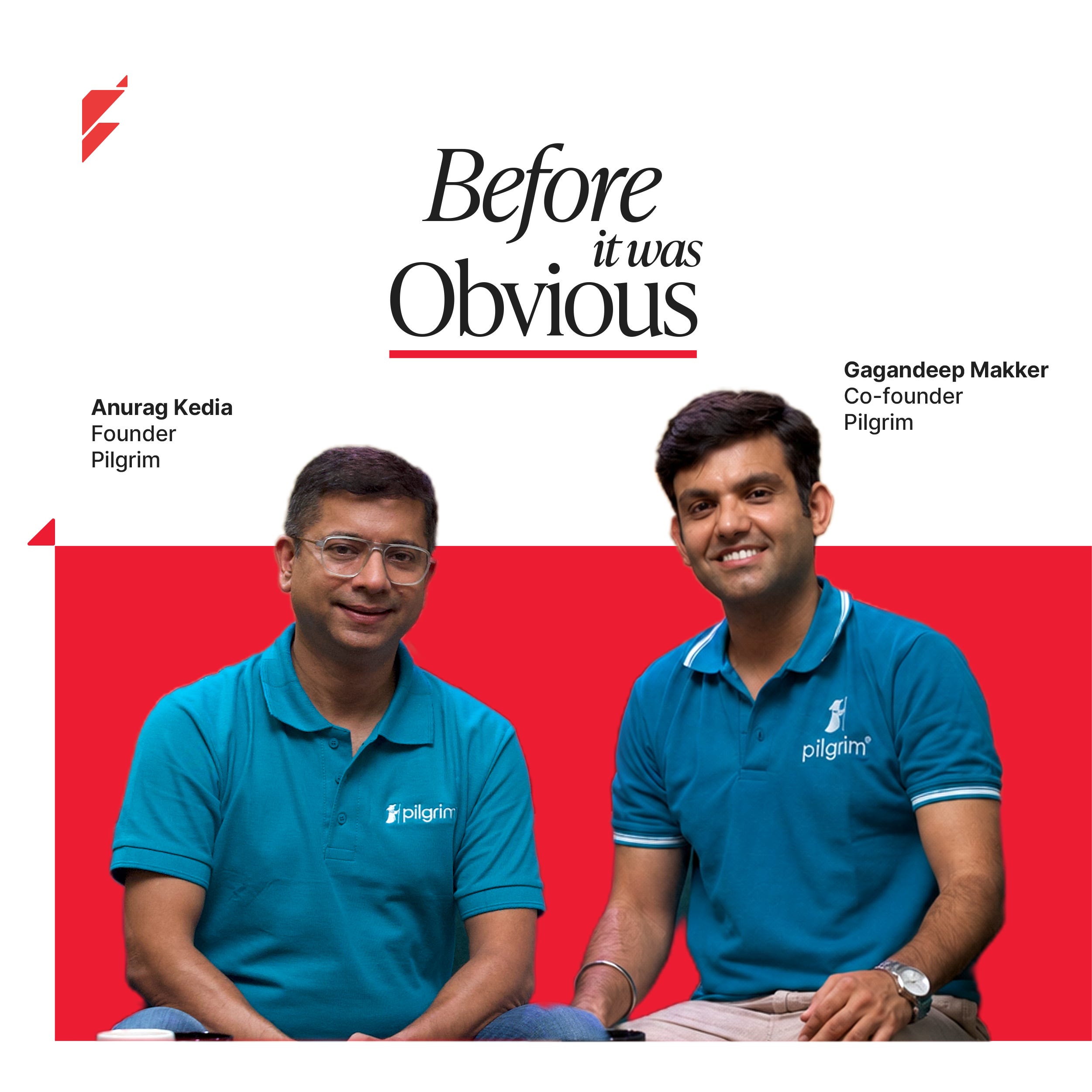
Most of what you see about the companies you admire, the funding announcements, the revenue milestones, the category leadership is the finished product. It’s the version of the story that makes for great retrospectives.
With Pilgrim, we’ve had the privilege of watching the less visible version: the debates, the data, the calls that looked uncertain at the time and only made sense later. What follows are five decisions from Pilgrim’s journey that we think every founder building in the D2C space should understand.
1. They built a brand identity around a clear point of view, not a category
Most beauty brands in India launched with a clear category anchor, Korean beauty, Ayurveda, clinical skincare. Pilgrim did something different. From day one, the brand was built around a philosophy: that the best beauty ingredients exist everywhere in the world, and that Indian consumers deserve access to them at prices that actually make sense.
That philosophy, the traveler searching for the world’s best-kept beauty secrets, shaped everything from their first product formulations to how they thought about expansion. Korean Tea Tree, French red wine, Amazonian Patauá: each ingredient had a reason to exist in the portfolio, and that reason was always the same. Does it deliver a measurable result for the consumer?

What this created over time was a brand with a very broad ingredient range but a very consistent point of view. Consumers didn’t need to understand the category geography. They understood what Pilgrim stood for: if you want the best, we’ve already looked for it.
The validation came not from category benchmarks but from consumer data. Pilgrim’s repeat rates and consumer feedback told a consistent story early on, the positioning was landing. The brand that could have been described as “hard to box” was being understood, and trusted, by exactly the consumer it was built for.
2. Consumer-first was a decision-making system, not a brand line
The principle of starting from the consumer and working backwards sounds obvious. In practice, it is one of the hardest disciplines to maintain as a brand scales and Pilgrim built it into the operating rhythm of the company from early on.
Every month, Pilgrim’s CMI team runs continuous research, qualitative and quantitative, across Indian and global marketplaces. Before any product goes to market, it goes through what the founders call The Secret Circle: a blind test with 200–300 consumers, benchmarked against the best-performing product already available. A Pilgrim product earns its launch by demonstrating superiority.
This same thinking guided their formulation strategy. The insight that shaped Pilgrim’s product architecture was that ingredients alone are not the differentiator. What matters is whether the final formulation delivers a measurable result for the consumer. Blend matters as much as sourcing- French red wine plus retinol, Patauá from the Amazon plus keratin. The consumer’s question is always the same: did it work?
For startup growth strategy more broadly, the discipline of embedding consumer voice structurally into the build process, not consulting it at the end as a validation exercise, is one of the most reliable predictors of retention performance as a brand scales.
3. The offline move was triggered by a metric, not a revenue milestone
Moving from online to offline is one of the most consequential calls a D2C brand can make. Pilgrim made it at ₹100 crore in revenue but the revenue figure was not the trigger.
The trigger was brand track data.
Pilgrim invested in quarterly brand tracking from an early stage, measuring top-of-mind awareness, category recall, and brand consideration scores among their core online consumer cohort. The threshold they set: when top-of-mind awareness among online buyers crossed 35–40%, the brand had earned the right to go offline. That number represented enough pull to justify an assisted shelf presence.
When the scores crossed that threshold, Pilgrim moved with a rigour that reflected everything they had learned online:
Two cities first- Delhi and Mumbai
The assisted route only: beauty advisors because if you cannot sell with human support, you have no basis for expecting unassisted sell-through
Competition benchmarking at the store level across comparable digital brands
D2C pin code data overlaid to identify geographies where Pilgrim consumers already lived
Early traction in beauty advisor channels was strong. South was added after 6–8 months. East after a year. Modern trade tests began in Mumbai, the strongest market once the assisted channel had proven the demand. Each expansion was triggered by proof, not ambition.
The lesson for any founder navigating the online-to-offline question: readiness is not a question about the company. It is a question about the brand and that readiness can be measured.
4. The best product innovation came from watching consumers hesitate
Pilgrim’s 10 ml serum is now one of their highest-velocity SKUs. It was not a technical innovation. It was a price-point and access innovation, one that came from watching consumers hesitate at the ₹600–700 barrier for a full-size serum and asking the right question: is this hesitation about money, or about risk?

The answer was risk. A consumer buying a serum for the first time doesn’t know if it will suit their skin. A 10 ml pack at a fraction of the price removes that barrier. It gives the consumer enough product to see early results and early indicators of compatibility are enough to convert a trial into a repeat purchase cycle.
What began as a trial format became a meaningful category entry point and a genuine volume driver. More importantly, it demonstrated something that holds across most consumer categories: the best entrepreneurship lessons often come not from the product itself, but from observing what is stopping the right consumer from buying it and making the smallest possible change to remove that friction.
The consumer doesn’t always need a better product. Sometimes they need a lower-risk way to try the one you already have.
5. Internal communication became a strategic priority as the team scaled
There is a phase in every scaling brand’s journey where the founder’s ability to hold the organisation in their head breaks down. For Pilgrim, the shift was felt acutely as the team grew from 6 to 15 to 35 and beyond.
In the early years, information moved organically. A product launch, a supply issue, a strong week of NPS- everyone knew, without anyone having to decide to share it. As the organisation grew, that stopped working. Teams began operating on different versions of the company’s reality.
Building deliberate communication mechanisms- the forums, the cadences, the explicit acts of telling people what is happening and why became as strategically important as any product or channel decision. It is not glamorous work. But it is the work that determines whether a company’s culture survives its growth, or gets quietly replaced by something less intentional.
The parallel shift was in how the founders spent their time. In the early years, everything was execution. As the team grew, the role inverted: the most important thing became grooming the leaders who run the functions, giving specialists the environment and confidence to move faster than the founders ever could alone. Gagan put it plainly, the hardest part of building a large team is not finding great people. It is creating the conditions where great people can do their best work without needing you in the room.
That transition is uncomfortable. It is also, almost without exception, when the company starts to compound.
Pilgrim’s journey is not a story of a brand that avoided hard decisions. It is a story of a brand that made hard decisions well, by staying close to the consumer, by using data to earn the right to expand, and by building systems that could scale what the founders had started.
The brands that endure are rarely the ones that moved fastest. They are the ones that moved with the right information, at the right time, with the discipline to test before they scaled.
Watch the full episode here: